Animal Crossing Location

ANIMAL CROSSING 

NIGHTS

LOCAL ARTISTS

INSTALLATIONS

VISITORS
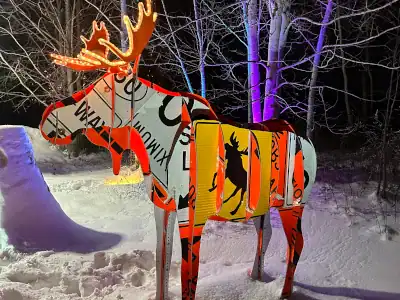
An artist's rendering of the installation: Animal Crossing Location. A moose and calf cross at a crosswalk.

ANIMAL CROSSING.

HUMAN/ANIMAL INTERACTIONS.

The moose is a quintessential Canadian animal, massive, iconic, and wild. It represents the strength and beauty of the northern landscape. Animal Crossing reimagines this familiar creature through a sculptural language rooted directly in the materials of human infrastructure. Constructed from recycled aluminum traffic signage, the piece transforms the very artifacts of the road into the form of the animal they both endanger and attempt to protect.

This installation embodies the collision and coexistence of human and animal worlds. By reusing decommissioned traffic signs that were discarded, the sculpture gives new life to materials designed for safety and regulation. In this new context, they become a reminder of the animals we share the road with and the necessity of considering how our infrastructure can threaten their existence.

The moose’s interlocking body panels were created by first mounting the recycled signs onto sheets of substrate using metal rivets. These sign-faced sheets were then water-jet cut into the precise shapes that form the moose’s body. Their reflective surfaces and bold graphics create a mosaic that links the animals form to the visual language of the roadway.

The finished panels fit together without visible fasteners, emphasizing modularity, craft, and sustainable reuse. The legs are supported by reused U-channel posts, the same material used for traffic signage, mounted to a white powder-coated steel base that blends into the snow.

The two orange barricade lights at its base help to reinforce the traffic-safety narrative. They are familiar roadside objects used in a new way to strengthen the visual connection between the sculpture and roadwork infrastructure. The moose antlers are the only part of the sculpture that is directly lit, and this is intentional. The illumination draws the viewer’s eye to the focal point of the sculpture, a reminder that failure to heed road signage can mean the difference between safety and harm for both people and wildlife.

By reworking everyday road materials into a new form, Animal Crossing encourages a moment of awareness about coexistence and the responsibilities that come with it.

ABOUT THE ARTISTS

Daniel Wray, Jordan Bussiere & Ethan Rozendaal.

Daniel Wray, Jordan Bussiere, and Ethan Rozendaal are Edmonton-based intern architects who met while completing their Master of Architecture degrees at the University of Calgary.

Animal Crossing was an opportunity to apply their shared technical and design skills at a smaller, more hands-on scale than their architectural work typically allows.

As emerging professionals, they were drawn to the chance to take a project from concept to construction, engaging directly with materials and fabrication. The process was both practical and rewarding, offering a rare opportunity to build something themselves and see a design come to life within a short timeline.

Born and raised in Edmonton, the trio saw this installation as a meaningful way to give back to the community that shaped them.

They have also designed and created this year’s installation, Castor Lantern.

ZOOMINESCENCE ARTISTS 2025

MEET THE REST OF THE 2025 FINALISTS

Castor Lantern

CASTOR LANTERN

NIGHTS

LOCAL ARTISTS

INSTALLATIONS

VISITORS

An artists rendering of the Castor Lantern Installation: a beaver.

CASTOR LANTERN.

CELEBRATING CANADA’S MOST ICONIC ANIMAL.

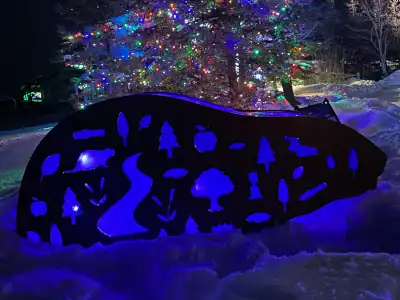
This sculpture, shaped in the iconic profile of a beaver, serves as a vibrant, illuminated tribute to one of Canada’s most emblematic and industrious animals.

Constructed using recycled metal framing, its perimeter holds translucent, blue-toned acrylic panels etched with delicate illustrations of beaver habitats, rivers, lodges, and wetland ecologies. These panels glow from within, creating a striking, educational light sculpture that invites viewers to engage with the environmental narrative it embodies.

The interior of the beaver’s form is filled with discarded plastic bottles, following the contours of the animal’s silhouette. This mass of waste materials serves as a visual metaphor for the ongoing human impact on natural ecosystems. As light passes through the translucent panels and refracts off the irregular surfaces of the bottles, the sculpture shimmers with moving reflections and ripple-like patterns, evoking water disturbed by their presence. This dynamic interplay of light and distortion symbolizes the disruption of the beaver’s habitat and the fragility of its world in the face of pollution.

Through its form, materials, and glow, the sculpture transcends being just a symbol of the beaver; it becomes a reflection of our relationship with the environment, inspiring dialogue, awareness, and a sense of stewardship.

The sculpture’s materials strike a balance between sustainability, durability, and narrative impact. The perimeter frame is made from recycled metal for strength and weather resistance, ideal for Edmonton’s climate. Blue translucent panels of recycled plastic, etched with beaver habitat illustrations, create a glowing ripple effect at night while reinforcing the environmental message. Inside, reused plastic bottles fill the beaver’s form, diffusing light and symbolizing the impact of human waste on ecosystems. The lighting system is securely housed to withstand seasonal conditions. Designed for modularity, the sculpture can be easily disassembled, transported, and stored, supporting reusability and future exhibitions. This careful material choice and design reflect a commitment to sustainability and responsible public art.

ABOUT THE ARTISTS

Jordan Bussiere, Daniel Wray & Ethan Rozendaal.

Jordan Bussiere, Daniel Wray, and Ethan Rozendaal are intern architects based in Edmonton. Each team member brings a diverse background in engineering, construction, and art. Their varied experiences enrich their collaborative approach, enabling them to design with both technical insight and creative depth. Having worked together on numerous projects, they have built a strong synergy rooted in shared values and a deep appreciation for Edmonton. They are passionate about creating designs that reflect Edmonton’s character, engage the public, and spark meaningful conversations.

They have also designed and created this year’s installation, Animal Crossing Location.

ZOOMINESCENCE ARTISTS 2025

MEET THE REST OF THE 2025 FINALISTS

Gulo Luna

GULO LUNA

NIGHTS

LOCAL ARTISTS

INSTALLATIONS

VISITORS

An artist's sketch of the art installation: Gulo Luna: A badger on a half moon.

GULO LUNA.

GULO GULO, THE WOLVERINE.

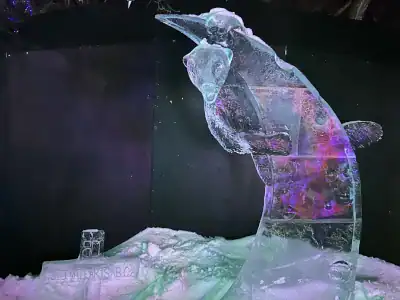
The Gulo Luna ice sculpture melds light and ice to celebrate the wolverine, a species that thrives in Northern Canada.

Predominantly nocturnal animals, Gulo Luna positions this rarely seen wonder on a half moon.

Wolverines can be vicious scavengers and hunters, and have even been known to take on much larger animals, such as mountain lions, moose, and elk. The American wolverine’s Latin name, gulo gulo, literally translates to glutton, glutton (haha!)

This sculpture was created on-site over two days, allowing visitors to the zoo to witness the creation process.

Made of ice and low-energy LED lights, this exhibit exemplifies our commitment to conservation. The wooden shade has been painted black to create a background that is ideal for pictures. 

ABOUT THE ARTISTS

CLIFF VACHERESSE & ANDREW WAGNER.

Gulo Luna was created by lead sculptor Cliff Vacheresse and sculptor Andrew Wagner, both of whom are sculptors with Activate Arts Alberta (formerly the Ice on Whyte Festival Society). Together, they have over 20 years of combined experience in ice, sand, and snow sculpting. Most recently, they created two wildlife-inspired sculptures for Ice Magic 2025 in Lake Louise: a Lynx and an Owl.

ABOUT CLIFF VACHERESSE.

Cliff Vacheresse started his ice and snow carving career in 2011 by helping build slides and mazes for the Ice on Whyte (IOW) Festival in Edmonton, Alberta. As time passed, he gained enough experience to become the festival’s lead sculptor.

Cliff works full-time every winter, from November until March, planning, executing, and leading a team for festival builds for towns all over Alberta. His works have been featured at High Level’s Frostival, Grande Prairie’s Grande North Winter Festival, and Lake Louise’s Ice Magic.

In 2015, Cliff began sand carving and, in 2022, was invited to contribute to the ‘A World of Sand’ exhibit in Søndervig, Denmark. This is Cliff’s sixth year contributing ice sculptures to Zoominescence. His previous masterpieces include Polarset, Reigning Light on the Caribou, and Curious Firefox.

ABOUT ANDREW WAGNER.

Andrew Wagner is an Edmonton sculptor, who has created works for Ice on Whyte, Grande Prairie’s Grande North Winter Festival, and Lake Louise’s Ice Magic. This is Andrew’s first time contributing to Zoominescence. 

Follow Activate Arts: 

activateartsab.ca

ZOOMINESCENCE ARTISTS 2025

MEET THE REST OF THE 2025 FINALISTS

Hidden Giants

HIDDEN GIANTS

NIGHTS

LOCAL ARTISTS

INSTALLATIONS

VISITORS

An artists rendering of the installation Hidden Giants: A sturgeon

HIDDEN GIANTS.

RIVER LIFE ELEVATED.

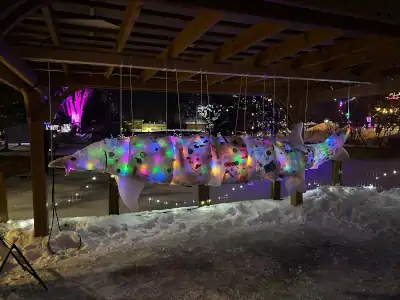
Hidden Giants elevates secretive Lake Sturgeon to ethereal heights, inspiring a sense of connection and awe with one of our largest and most unseen neighbours, and the protection of our waterways.

Lake Sturgeon, Alberta’s largest and oldest fish, can be found in the North and South Saskatchewan Rivers. True river monsters, they live long and secretive lives. Within our rivers, these hidden giants are listed as a threatened species, their populations declining due to overfishing, habitat degradation, pollution, and the construction of dams. Thanks to recovery efforts, their populations are slowly rebounding.

Created with almost exclusively recycled plastics, including litter collected from Edmonton’s river valley, Hidden Giants highlights the dangers and potential of single-use plastics.

Suspended in the air, this larger-than-life Lake Sturgeon is hollow and open on the bottom, allowing visitors to duck their heads into it and become one with the great fish. Inside, a galaxy of stars and layers of light surrounds the viewer. The fish’s body is articulated, swaying gently and organically, like a fish swimming downriver.

In addition to recycled plastic, this fourteen foot long installation is made from wire, chain, and a wooden frame. Energy-efficient LED lights and minimal new material make this piece highly sustainable.

ABOUT THE ARTISTS

ELIAS SEEMANN.

Elias Seemann is a mixed-media Surrealist artist based in Edmonton. They recently graduated with distinction from MacEwan University with a Studio Arts Diploma. Working primarily with acrylics and recycled materials, Seemann is known for their large-scale installations and sculptures. Their works are vibrant and unusual, with a focus on ecology and liminal spaces, often implementing Surrealist Automatic art processes. Their work is influenced by their passion for biology, Surrealism, existential philosophy, and the psychedelic movement.

Elias’ creative team includes their husband, a dedicated Studio technician highly skilled at building and logistics. Together, they make a powerhouse team.

Seemann has primarily exhibited their work at Macewan University during their studies, winning second place in Macewan’s 50th Anniversary Studio Art’s Prize in 2022 for their work after-life. They have also exhibited with the Alberta Society of Artists in Calgary in 2023 and the Edmonton Works Art and Design Festival in 2017. In 2024, Seemann also taught a workshop through the Mitchell Art Gallery on Surrealist Automatic Practices. 

Fascinated by the weird and unsettling, Seemann’s work fights back against societal taboos surrounding the strange and unseen parts of the natural world.

Follow Elias Seemann:

weirddeerart.squarespace.com

ZOOMINESCENCE ARTISTS 2025

MEET THE REST OF THE 2025 FINALISTS

Neighbours of the North

NEIGHBOURS OF THE NORTH

NIGHTS

LOCAL ARTISTS

INSTALLATIONS

VISITORS

An artist's rendering of the installation Neighbours of the North: a wolf on black background.

NEIGHBOURS OF THE NORTH.

THE BEAUTY & MYSTIQUE OF THE ARTIC WOLF.

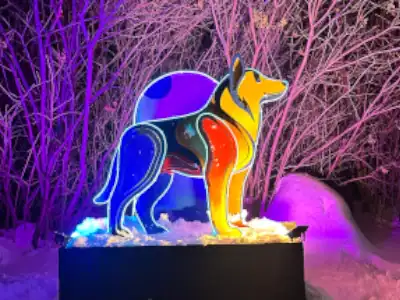
Neighbours of the North celebrates the captivating beauty and mystique of the Arctic wolf, the opening of the R. Mallot Arctic Wolf Habitat, and our new wild neighbours, Aspen & Anuri, who now call the Edmonton Valley Zoo home.

Following the tragic death of his partner, Shilah, in 2022, zookeepers spent more than a year searching for suitable companions for Tundra. In 2024, Aspen and Anuri joined the Edmonton Valley Zoo from France as Tundra’s new packmates. 

The Valley Zoo Development Society, in partnership with the Malliner Charitable Foundation, immediately initiated the creation of a new wolf habitat. A home that focused on cognitive challenges, play, and natural expression, while promoting awareness about their conservation needs. The R. Mallot Arctic Wolf Habitat was opened in the spring of 2025, allowing visitors to see Tundra and his pack thriving in their upgraded home.

This new habitat stands as a testament to the zoo’s commitment to animal welfare, fostering meaningful connections between wildlife and the community, and serves as a reminder of the importance of protecting and conserving the fragile northern landscapes that Arctic wolves depend on to thrive.

Brighly lit, Nieghbours of the North, shines like the northern star, welcoming and celebrating our Arctic friends.

This installation is constructed from layers of plywood, painted in bright colors to create a glowing effect beneath blacklight spotlights. Further illumination is provided by energy-saving LED rope lights.

ABOUT THE ARTISTS

ANTHONY ESLAVA.

Like a lone wolf, the creative force behind this installation is Anthony Eslava from AceWood Co. Anthony is a carpenter and woodworker from Edmonton, Alberta. Anthony’s enthusiasm lies in seamlessly merging artistic expression with the inherent beauty of natural materials. 

Anthony crafts public art pieces that unite people, illuminate spaces, and serve as a powerful artistic voice, conveying a deeper message. Through his company, Ace Wood Co., Anthony helps people create their dream environment with unique, thoughtfully designed items. 

This installation marks Anthony’s third year lighting up Zoominesence with public art. His past exhibits, “Northern Spirits”, “Grevy’s Glow”, and “Stripes in the Shadows”, have each brought imagination and wonder to the night.

Follow Anthony Eslava:

ZOOMINESCENCE ARTISTS 2025

MEET THE REST OF THE 2025 FINALISTS

Night Flight

NIGHT FLIGHT

NIGHTS

LOCAL ARTISTS

INSTALLATIONS

VISITORS

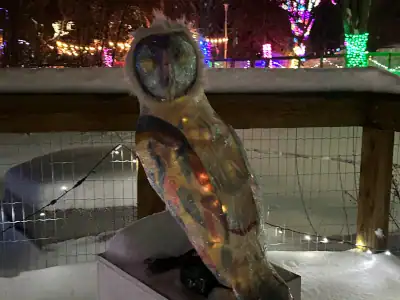
An artist's rendering of the installation Night Flight, a glowing Owl.

NIGHT FLIGHT

SPOTLIGHT ON OUR GHOSTLY WILD NEIGHBOURS.

Like a ghost in the night, Night Flight pays homage to the nocturnal North American Barn Owl.

Barn Owls are birds of prey. Specialized hunters at the top of the food chain, they possess excellent low-light vision and can easily spot prey in the darkest of nights. Even more incredibly, their ability to locate prey by sound alone is the best of any animal that has ever been tested.

Rather than building a nest, Barn owls lay their eggs directly onto the previous year’s nest debris—a compacted layer of owl pellets.

The Barn owl is a vital part of its ecosystem, serving as a scavenger while helping to control pest populations. Night Flight showcases the balance these creatures maintain within their ecosystem and the longevity they can achieve with minimal detriment to their environment.

Night Flight’s stylized feathers and ghost-like physical features highlight the owl’s cunning and quiet nature. LED lights running through the sculpture reveal these well-known, yet seldom-seen, wild neighbours.c While recycled and reused elements reference the craftiness and scavenging nature of the barn owl.

By reflecting on the natural conservation and stewardship embodied by the barn owl, Night Flight encourages visitors to reflect on how they can reduce their own ecological and carbon footprint while continuing
to grow in balance with their own surroundings.

Night Flight has been constructed with semi-transparent, stretchable fabric from reuse centers, as well as vellum paper (transparent, coloured paper), bendable metal wire, wood, and cardboard. This sculpture is illuminated by battery-powered, LED string lights, set on timers.

ABOUT THE ARTISTS

ERIC NOCENTE.

Eric Nocente is a local visual artist whose work focuses on human nature and its interconnectedness to the natural world. With over eight years of experience creating sculptures, his work includes various installations around the city, such as the African Spurred Tortoise featured during Zoominescence 2021, the Red Fox at Zoominescence 2019, the Stollery Children’s Hospital front entrance bear, the Canadian Brewhouse Inukshuk, and numerous other sculptures at local mini-golf courses and businesses.

Outside of sculptures, Eric has exhibited illustrations and paintings at numerous venues, including the Rutherford Library at the University of Alberta, as well as at venues in Montreal, Canada, and California, U.S.A.

Follow Eric Nocente:

ericnocente.bigcartel.com

ZOOMINESCENCE ARTISTS 2025

MEET THE REST OF THE 2025 FINALISTS